Saudi Arabia Under Fire: Tehran Strikes Gulf Allies as Regional Rapprochement Collapses
The Iranian missile and drone barrages that struck Saudi Arabia, the United Arab Emirates, Bahrain, and Kuwait in the opening days of the 2026 Iran-Israel war have effectively destroyed the diplomatic architecture that the two Gulf rivals had painstakingly constructed over three years of quiet reconciliation — and have placed Saudi Arabia at the center of a regional security crisis that its leadership had worked assiduously to avoid.
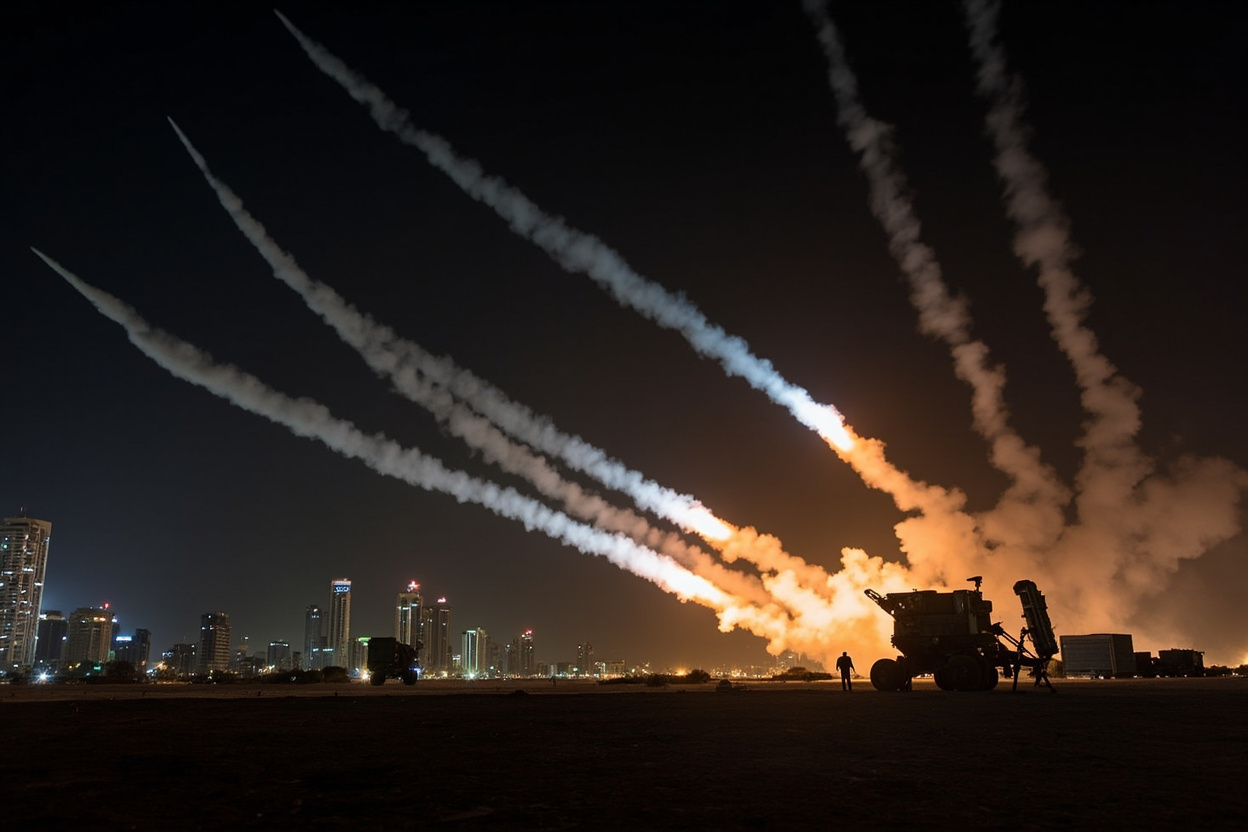
On March 2 and 3, the first 48 hours of the US-Israeli air campaign against Iran, Iran's Islamic Revolutionary Guard Corps launched more than 140 missiles and drones at targets across seven countries in the region, including Saudi Arabia. Saudi air defense batteries — including the US-supplied Patriot systems and the advanced THAAD battery Riyadh acquired in 2022 — intercepted the majority of incoming weapons, but at least 23 projectiles reached their targets, striking a petrochemical facility near Dammam, a military radar installation in the Northern Border Region, and a civilian power grid node that knocked out electricity to approximately 200,000 homes in the Eastern Province for 72 hours.
The strikes on Saudi Arabia were particularly significant because they came less than three years after the two countries had re-established full diplomatic relations in March 2023, brokered in a secret Beijing-brokered deal that ended seven years of severed ties following the 2016 execution of prominent Saudi Shia cleric Nimr al-Nimr and the subsequent storming of Saudi diplomatic missions in Iran. The rapprochement had been celebrated as one of the most consequential diplomatic achievements in modern Middle Eastern history, opening the possibility of a comprehensive regional security framework that would have included Iran.
Saudi officials have been unequivocal in their condemnation. Foreign Minister Prince Faisal bin Farhan said during an emergency Arab League session that Iran's attacks on Saudi territory were "an act of naked aggression that betrays all the trust we painstakingly built over three years of genuine reconciliation." He warned that "Saudi Arabia will take all necessary measures to defend its people, its territory, and its sovereignty, in accordance with international law." The kingdom's Defense Ministry announced the mobilization of its full air defense network and the deployment of additional forces to its northern and eastern borders.
The attacks have also severely strained the UAE, which Iran struck with at least 12 projectiles on March 3, striking the Jebel Ali industrial zone near Dubai and causing a fire at a petrochemical storage facility. The UAE Foreign Ministry summoned Iran's charge d'affaires in Abu Dhabi to deliver a formal protest, and Emirates airlines announced the suspension of all flights to destinations in Iran, Iraq, and Lebanon. Kuwait was also struck, with at least four missiles penetrating its northern air defenses and striking a rural area near the border with Iraq, though no casualties were reported.
Regional analysts say the attacks on Gulf countries reveal the fundamental fragility of the Saudi-Iranian rapprochement — and the degree to which it was always contingent on the absence of a major regional crisis. "The reconciliation was real, but it was built on a shared interest in de-escalation, not on any fundamental change in the strategic rivalry between Riyadh and Tehran," said Dr. Tarik Al-Baker, director of the Gulf Research Center in Geneva. "The moment a real existential conflict erupted, both sides reverted to type."
The dilemma for Saudi Arabia is acute. Crown Prince Mohammed bin Salman has staked much of his Vision 2030 economic transformation agenda on regional stability and foreign investment. The missile strikes — and the visible failure of even the most advanced American air defense systems to guarantee complete protection — have rattled international investors and raised serious questions about Saudi Arabia's ability to maintain the security environment necessary for its economic ambitions. The Saudi stock market fell 8.4% in the first week of the strikes before partially recovering, and several major Western investment banks issued advisories cautioning clients about the deteriorating security situation in the Gulf.
At the same time, Saudi Arabia cannot afford to be seen as passive in the face of Iranian aggression — either domestically, where a public expectation of muscular retaliation has built up, or regionally, where its credibility as the leader of the Gulf Cooperation Council depends on demonstrating that it will defend its allies. The kingdom has sought to thread this needle by providing substantial logistical and intelligence support to the US counter-blockade operations in the Gulf, while publicly calling for an immediate ceasefire and a political resolution.
The broader implications for Middle Eastern geopolitics are deeply troubling. The Saudi-Iranian rivalry has been the central organizing conflict of the Middle East for four decades, and the architecture of alliance systems, proxy conflicts, and sectarian mobilization that it generated was responsible for catastrophic wars in Yemen, Syria, and Iraq. The 2023 reconciliation offered the first real prospect in a generation of winding down that rivalry. What the 2026 war has demonstrated is that the underlying structural tensions — over regional hegemony, the role of religion in statecraft, and the competing alliances with Washington and Tehran — were never resolved. They were merely suspended.
To be configured
Related Coverage
Related Articles